

Just north of Taipei is a place called Keelung, known romantically as the rainy city of Taiwan. Keelung boasts night markets, hiking trails, and numerous other attractions. Just outside Keelung City lies Liu Mingchuan Tunnel –rich with history and well worth the walk.
The History of Liu Mingchuan Tunnel
Before the Japanese occupation of Taiwan, the Qing Government built the Liu Mingchuan Tunnel (劉銘傳隧道) between 1888 and 1890 to connect Taipei to the north. The tunnel was built to replace older routes and facilitate rail transport.
The tunnel was dug from both the south and north entrances with the goal of meeting in the middle — initially as a way to improve efficiency. Due to miscalculations, there are slight differences in height at both ends.
British and German engineers were hired as design consultants and construction supervisors, yet even with their expertise, the tunnel collapsed during construction. Mostly soldiers worked on the tunnel, and 30 months later it was fully operational.

How to Get There
It’s only a 20-minute walk from Keelung Station. You step through the winding streets of Keelung and make your way toward the tunnel. There are two entrances: a north entrance and a south entrance.
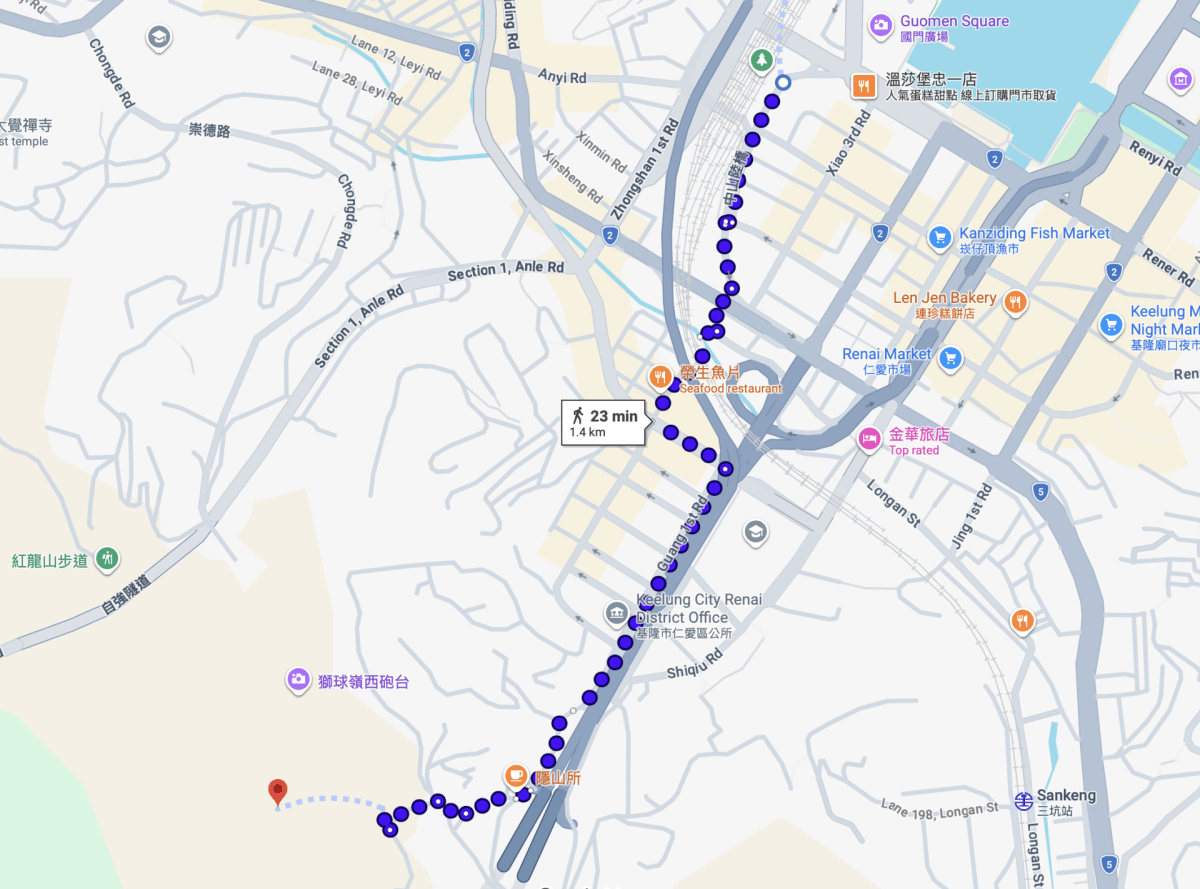
I took the south entrance up toward a temple(Shiqiuling Pingan Temple), where you get a panoramic view of Keelung and the port. After meeting some friendly locals who showed me where to go, I walked down a few flights of stairs past beautiful ferns and lush tropical rainforests. The jungle smiles with greens and amber hues of trees and plants.


The south entrance is a tropical haven. You’ll be met by a small planted raised garden bed, running water, and green moss, all framed by a 4–5 metre-high wall.

The north entrance tells the historical story, with informative plaques about the tunnel’s history lit up along the wall. Before you even enter, the sound of a small waterfall makes the whole scene feel like a time capsule.
Travel Tip: Get there around 9–10am, as the light dances and filters beautifully through the trees.
What to See in the Tunnel
Tread carefully and with imagination. Think back to how a train could fit beneath the 4.5-metre-high ceiling of stone and brick — the width just wide enough to stretch your arms out and touch both sides.


Today, the sandstone, moss, and darkness host bats, spiders, and other critters, while the lights create a playful dance of shadow and glow.
Through the 235-metre-long tunnel, you'll notice square holes carved into the walls and a subtle light display.


The architecture and engineering are a marvel, both functionally and aesthetically.The side walls of the tunnel are built from sandstone using the 'Ding-shun' (Header and Stretcher) bond. From these walls, the arch begins to curve upward, uniquely constructed using a combination of Guanyinshan stone and red bricks.[1]
Meet the Locals: The Formosan leaf-nosed bat
The tunnel isn't just a historical landmark; it’s a vital sanctuary for the Formosan Leaf-Nosed Bat, an endemic subspecies of Taiwan. These fascinating creatures live in caves and use ultrasound to hunt large insects, such as beetles.[2]
If you are visiting during the warmer months, please be extra mindful of their life cycle:
March – April: Pregnant females can often be spotted.
April – June: The primary breeding season.
May – August: The critical period for birth and nursing their young.
Responsible Visiting Tips
To ensure these unique neighbors aren't disturbed, the government strictly regulates visitor numbers. Please follow these "Eco-Friendly" rules:
- No Flash/Lights: It is strictly forbidden to shine flashlights or phone lights directly at the bats.
- Keep Your Distance: Observe them from afar and avoid standing directly underneath them.
- Keep it Quiet: Try to keep noise levels down to avoid startling the colony.
Visitor Information
The Liu Ming-chuan Tunnel is a must-visit for history buffs and urban explorers alike. You can choose to wander through at your own pace during opening hours or join a scheduled guided tour for a deeper dive into its stories. Best of all, no prior registration is needed—just head to the meeting point and feel free to join the group at any time!
Opening Hours: Tuesday – Sunday, 9:00 AM – 5:00 PM (Closed on Mondays).
Guided Tours: Available every Friday, Saturday, and Sunday.
Times: 10:00 AM and 2:00 PM daily.
Duration: Approximately 20–30 minutes. (Just follow the guide to listen in!)
Tour Meeting Point: The Duty Room outside the tunnel entrance (Near No. 129, Chongde Rd., Anle Dist., Keelung City).
Important Note: Protecting the Bat Colony
To minimize disturbance to the resident bat population, visitor capacity is strictly regulated.
- Capacity Limits: Depending on the month, the maximum number of visitors allowed inside ranges from 30 to 80 people.
- Winter Exception: There are no capacity limits from December to February (as the bats are less active).
- Pro Tip: Before you head out, I highly recommend checking the latest announcements from the Keelung City Government to confirm current visitor limits and accessibility!
Nearby Attractions
Make the most of your visit by checking out these gems just a short walk from the tunnel:
Keelung.rcu(隱山所) coffee shop
Address: No. 116號, Lane 48, Shiqiu Rd, Ren’ai District, Keelung City, 200
Shiqiuling fort(獅球嶺炮台):
Address: Shiqiu Rd, Ren’ai District, Keelung City, 200
More about the fort: 7 Historic and Forgotten Forts Around Keelung
[1] National Cultural Heritage Database, https://nchdb.boch.gov.tw/assets/advanceSearch/monument/20100728000002
[2] The Central News Agency, https://www.cna.com.tw/news/aloc/202404130239.aspx; Taiwan Encyclopedia of life, https://taieol.tw/pages/75579


Leave a Reply