

 Around the Kiirun port 1930s. Source: Wikimedia Commons
Visiting Kiirun
The scent of steady downpour of the rain having drummed against the pavements and rooftops just a moment ago lingered in the ambience. It was as if the rain had swept away the weight of the city’s problems, leaving a fresh canvas behind. Kiirun, Taiwan’s most important port, is infamous for its weather during the rainy season. Breathing in the fresh, yet stiflingly humid air, a group of pilgrims including myself stepped out of the railway station. My journey began in Taihoku; however, many of the other believers came from much afar – all to worship the black-faced Mazu. The local festivals have long drawn people from across the island, some even from Tainan! It is said that just a few years ago, nearly fifty thousand visited Kiirun to celebrate the festival of black-faced Mazu[1].
As such, the main destination of my voyage was the island-wide centre of the cult, Qing’an Temple. Before offering my prayers, I have decided to stroll around the ‘Big Kiirun’ – a densely inhabited and central area of the city, mostly populated by the islanders around the older chinese districts. This place has been much more familiar to me, especially in contrast to a much more Japanese-dominated ‘Small Kiirun’, located further inland and upstream from the main urban port area.[2]
 Keelung Railway Station during the Japanese colonial period. Source: Wikimedia Commons
Leaving the station with the elegantly crafted brick clock tower, I meandered along the harbour. In front of the station, I saw a coral first-hand sales shop.
 1952. Ping He Tang in front of Keelung Station.《臺灣風景寫真帖》, p.15. Taiwan Library Ebooks, National Taiwan Library, Book ID: 0748 89。
Inside, the shop was neatly arranged with counters displaying various items—likely coral, books, and stationery. Behind the counter, a man stood attentively, overseeing the business, while another sat nearby, perhaps engaged in tallying sales or organising goods. Customers leaned in to examine the products, discussing prices and making their selections[3].
 Author: Katsuyama Yoshisaku/ 勝山吉作. Coral of Keelung. Collection: Academia Sinica. Digital Collection: Academia Sinica Center for Digital Cultures (Public Domain Mark)
I wandered a few streets further into the city, heading toward a market that had been my favourite since my first visit here two decades ago. Once chaotic and unsanitary, it had transformed into a model of hygiene and organisation. Vendors proudly displayed fresh fish caught off Keelung’s coast, alongside vegetables from Ranyan (蘭陽) and Taihoku. The food market thrived as locals mingled, exchanging friendly banter while shopping for high-quality goods at affordable prices. Nearby, stalls overflowed with fruits, primarily sourced from central and southern Taiwan, while meats were purchased from local farms. The air was filled with enticing aromas and lively conversations in a blend of Hokkien and Japanese.[4]
 Gijucho Street. Source: Verse
That blend mirrored the market’s deeper divides. As I walked through the busy stalls, the subtle differences between us were impossible to ignore. Japanese settlers, with their higher wages, could afford the finest cuts of meat and the freshest produce, while many islanders had to be more selective, careful with each coin spent. Despite sharing the same market, the wage gap – two or three times in favour of the Japanese – was a constant undercurrent, visible in what we bought and how we moved through the space. Here, many of the Japanese settlers, particularly from Kagoshima and Nagasaki, worked in the fishing industry, supplying the market with the freshest catches from nearby waters. Though we worked side by side in the shops and stalls, the market was a quiet reminder that, in the eyes of the empire, the islanders and the mainlanders would never truly be equals. [5] [6]
 Keelung Station and Keelung Port (1930s). Source: Wikimedia Commons
As I left the marketplace, I strolled back along the canal, back to the harbour. The walk reminded me just how much the city had transformed in the past few decades. I had heard stories from my friends, but seeing it with my own eyes was remarkable. Kiirun, once a small, unassuming port village, had grown into one of Taiwan’s most vibrant cities, largely owing to the empire-building efforts. The city’s harbour, shaped by years of colonial investment, now bustled with ships from all over the empire and beyond. Trade had shifted from China to Japan, with vessels entering the port in numbers that had skyrocketed since the handover, carrying rice, tea, coal, and other vital goods.
 Author: Katsuyama Yoshisaku/ 勝山吉作. Pier No. 2 at Keelung Harbor and Rice Exports. Collection: Academia Sinica. Digital Collection: Academia Sinica Center for Digital Cultures (Public Domain Mark)
The changes extended beyond the harbour. Japanese planners, eager to showcase their vision of modernity, had reimagined the city’s infrastructure. Roads, schools, hospitals, and even green spaces were meticulously designed, turning Kiirun into a symbol of the country’s global aspirations. The new parks on the hillsides and improved transport systems reflected their efforts to create not just a functional city, but a livable, “civilised” one. While the rainy weather and geographic limitations kept Kiirun from becoming a world-class port, the city’s transformation was undeniable, and the legacy of these developments would likely be felt for generations.[7]
Soon, I reached the Asahi Bridge and looked at the Keelung Post Office on the other side of it, a tall and sturdy building that stood as a beacon of reliability amid the bustling city[8]. Climbing the stone steps, I approached the window emblazoned with the words “Remittance Reserve Fund” (匯款儲金), where a line of people waited patiently to handle their money and remittances. This place served an impressive average of 800 customers a day, each transaction a vital link in the web of communication and commerce. In addition to its remittance services, the post office also offered insurance—pension and lifetime policies—which reportedly handled over 10,000 cases.
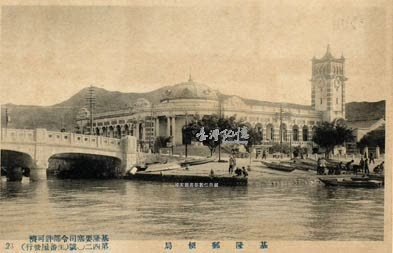 Postcard of Keelung Post Office (Circa 1930s). Source: National Central Library Taiwan
To the left, the telegraph and telecommunications department hummed with activity, where messages sent from Kiirun could reach Taihoku in just thirty minutes, and even Tokyo within two and a half hours—a marvel of efficiency in those times. Just beyond the post office, near the southern edge of Small Kiirun, lay the Public Welfare Society, an area traversed daily by hundreds of people crossing the bridge into Big Kiirun. Here stood the Public Hall, home to the Kiirun Public Welfare Society that pealed a bell at noon everyday, the bell ringing through the streets, keeping the compact city centre synchronized. It served as a reminder that time was a shared experience in our bustling community, binding us together in the rhythm of daily life.[9] [10]
 Keelung Post Office. Collection: The Archives of Institute of Taiwan History, Academia Sinica. Digital Collection: The Archives of Institute of Taiwan History, Academia Sinica(CC BY-NC 3.0 TW)
As I made my way toward Qing’an Temple, the streets felt quieter. I was about to step into a place that was not just any temple, but a cornerstone of Kiirun’s spiritual life. Built by Chinese settlers from Zhangzhou in the late 18th century, Qing’an Temple was dedicated to Mazu, the goddess who had long been revered by seafarers as their protector. This black-faced Mazu, with her solemn, watchful expression, had become central to the spiritual identity of the city. Over time, the temple established direct ties to the island of Meizhou in Fujian, the birthplace of Mazu worship. In 1914, the temple leaders even made a pilgrimage to Meizhou, returning with a palanquin that carried the goddess’ likeness—a shrine still used in their festivals today. Every year, during the Ghost Festival, this temple becomes the heart of the city’s offerings, filled with prayers and sacrifices.[11]
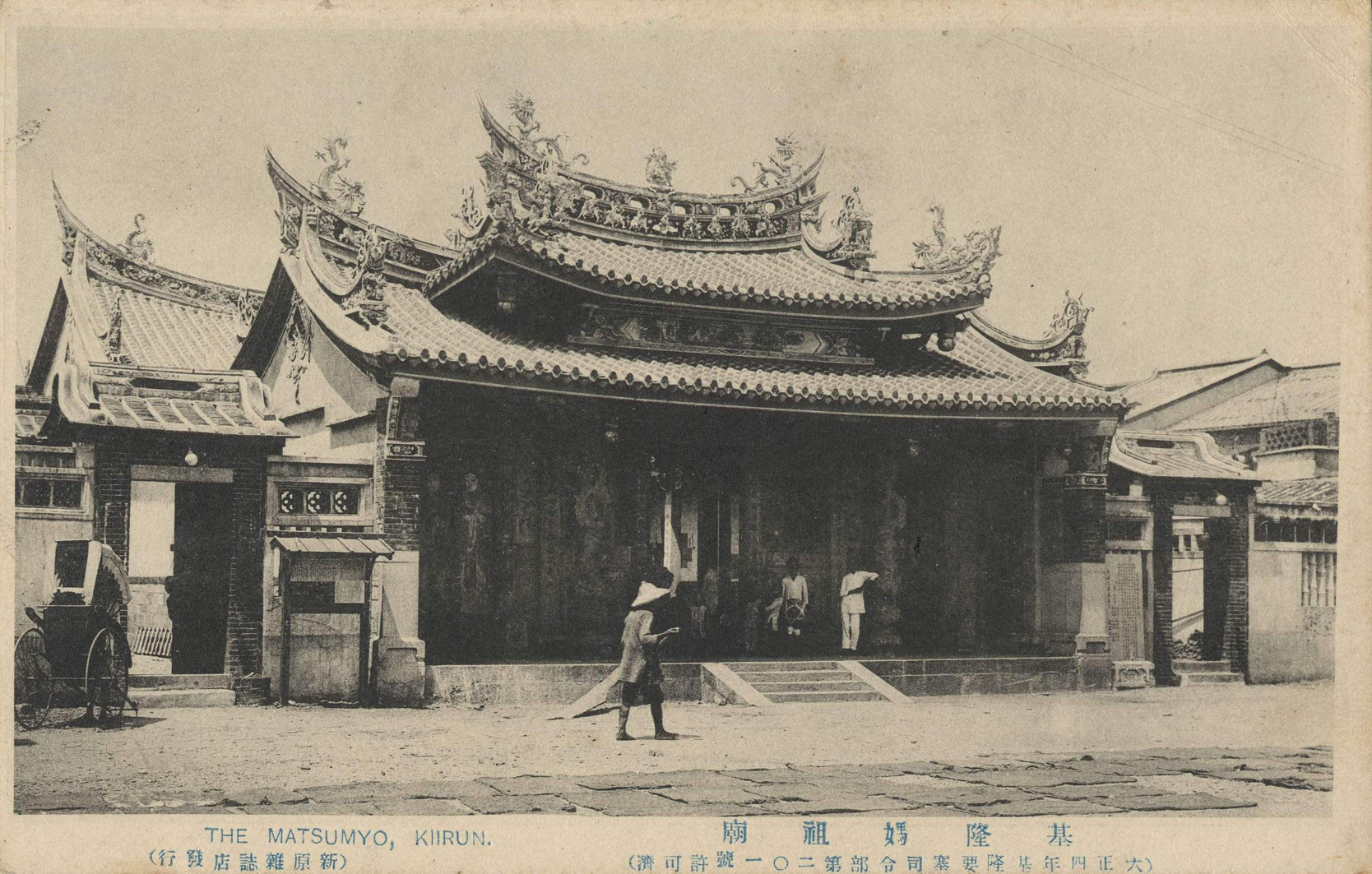 The postcard of the Qing’an Temple taken in 1915. Source: 基隆媽祖廟。Taiwan Memory, from https://tm.ncl.edu.tw/article?u=001_003_0000363486
I joined the throngs of pilgrims who, like me, knelt in prayer before the black-faced Mazu. The atmosphere was charged with anticipation for the upcoming festival, where offerings would be made in abundance, and thousands were expected to gather once again in celebration. After offering my prayers, I stood and observed fellow worshippers making their offerings, each hoping for Mazu’s protection as we faced the challenges of daily life. The community buzzed with excitement about the festival, a reminder of our shared beliefs and hopes. Leaving the temple, I felt a renewed sense of purpose, knowing the festival would soon bring us all together once more in reverence and celebration.
Author: Pan Yixing
[1] Evan N. Dawley, Becoming Taiwanese : Ethnogenesis in a Colonial City, 1880s to 1950s (Cambridge, Massachusetts: Harvard University Asia Center, 2019), p. 193
[2] Evan N. Dawley, Becoming Taiwanese : Ethnogenesis in a Colonial City, 1880s to 1950s (Cambridge, Massachusetts: Harvard University Asia Center, 2019), p. 61
[3] 林修澈 and 安郎三ッ橋, LÁN基隆:基隆市鄉土讀本[精裝] (國立臺灣圖書館, 2023), p. 487
[4] 林修澈 and 安郎三ッ橋, LÁN基隆:基隆市鄉土讀本[精裝] (國立臺灣圖書館, 2023), pp. 300-304
[5] Evan N. Dawley, Becoming Taiwanese : Ethnogenesis in a Colonial City, 1880s to 1950s (Cambridge, Massachusetts: Harvard University Asia Center, 2019), pp. 60-61
[6] “基隆港與港都人 – 時空旅行社|國家文化記憶庫2.0線上策展平臺,” Culture.tw, 2024, https://curation.culture.tw/curation/public?id=60.
[7] Evan N. Dawley, Becoming Taiwanese : Ethnogenesis in a Colonial City, 1880s to 1950s (Cambridge, Massachusetts: Harvard University Asia Center, 2019), pp. 47-52
[8] “臺灣記憶 Taiwan Memory,” Ncl.edu.tw, 2024, https://tm.ncl.edu.tw/article?u=001_003_0000363448.
[9] 林修澈 and 安郎三ッ橋, LÁN基隆:基隆市鄉土讀本[精裝] (國立臺灣圖書館, 2023), pp. 90-102
[10] Evan N. Dawley, Becoming Taiwanese : Ethnogenesis in a Colonial City, 1880s to 1950s (Cambridge, Massachusetts: Harvard University Asia Center, 2019), pp. 135-136
[11] Evan N. Dawley, Becoming Taiwanese : Ethnogenesis in a Colonial City, 1880s to 1950s (Cambridge, Massachusetts: Harvard University Asia Center, 2019), pp. 171-172

Leave a Reply